Introduction
Welcome to the course Writing Effectively for the Council of Europe.
This course focuses on the principles and strategies that underpin effective workplace communication:
- having a clear purpose;
- meeting readers' needs;
- writing clearly and correctly;
- paying attention to context.
This is how it works. You will explore principles and strategies of effective writing. You will consider these principles and strategies in the context of the Council of Europe's written communication needs. You will apply them through a series of self-marked, work-related writing activities and be assessed through a number of practical work-based tasks that will need to be performed to specified standards.
You will have a personal tutor to work with you throughout the course. In addition to helping you with any problems with learning materials and learning approaches, your tutor will give you detailed feedback on your assignments. Working with your tutor will give you an opportunity to revise things you have written with the assistance of someone whose primary concern is your writing. This is a unique opportunity.
Course outcomes
On completion of the course, you should be able to:
- produce work-based writing that is clear, concise, appropriate, accurate, informative and reader-focused;
- apply organisational, mechanical and process-based skills to the production of written documents.
Course outline
Writing Effectively for the Council of Europe is in modular format so that you can select those modules most relevant to your needs. Once you have successfully completed Module 1, you can choose to take either of the second-level modules. Both second-level modules will assume knowledge of the strategies, principles, and skills covered in Module 1. You will complete either Module 2A or Module 2B, but not both.
Below is an estimate of the amount of time it may take to complete each module.
- Module 1: Effective Writing: Strategies and Principles (16 hours)
- Module 2A: Writing short documents (18 hours)
- Module 2B: Writing reports and proposals (18 hours)
Note: hours required to complete each module may vary depending on the complexity of the documents you choose to work on, your language ability and your own writing experience and skills.
Module contents
Module 1: Effective writing: strategies and principles
This module operates as a foundation to the course. The skills and strategies learned here are applicable to all work-based writing tasks. It covers:
- defining your statement of purpose;
- analysing your audience;
- overcoming barriers to effective communication;
- adopting a writing strategy, framework and timeframe:
- prewriting
- organising
- drafting
- macro- and micro-editing
- proofreading
- writing coherent sentences;
- writing well-organised paragraphs.
Module 1 assignment
The assignment has two parts:
- analysing your strengths and weaknesses in writing, based on self-selected writing samples;
- creating a portfolio of examples of the principles discussed in this module, drawn from your writing.
Module 2A: Writing short documents
This module gives you guidelines for, and practice in, writing short documents. It covers:
- analysing your document's purpose and readers' needs;
- writing responsive and initiative correspondence;
- writing records of meetings;
- writing briefing notes;
- writing other short documents (including articles for social media);
- writing to Council of Europe specifications (using style guides and templates; analysing existing documents).
Module 2A assignment
The assignment consists of a portfolio of four short documents, representing the types of documents you usually produce at work. Short documents include e-mails, speeches, memos, meeting records, press releases, requests for tender, job descriptions and briefing notes, or other documents of a type you commonly write.
Module 2B: Writing reports and proposals
This module takes you through the process of writing a report or other long document. It covers:
- analysing your document's purpose and readers' needs;
- writing introductions;
- writing conclusions;
- writing recommendations;
- writing executive summaries;
- writing to Council of Europe specifications (using style guides and templates; analysing existing documents).
Module 2B assignment
You will produce either a short work-based report, including an executive summary, a proposal, or another document of 6-10 pages relevant to your work.
Features of the study materials
This course gives you relevant information about written communication that is designed to improve your professional writing at the Council of Europe. It aims to encourage you to reflect on your current work-related writing practices and to help you identify ways you can improve them. It encourages you to view your writing as a series of drafts, with each subsequent draft improved based on feedback either from others and on your own careful review.
Learning objectives
At the beginning of each module, we present you with some specific learning objectives, detailing what we expect you to get out of the module. These objectives are not all-encompassing; you will also have your own objectives. Once you have completed the module, we encourage you to revisit the objectives to reflect on whether or not you have achieved them.
Activities
Throughout each module, you will find two different kinds of tasks. The first, called activities, aim to get you to stop and think about what you have been reading, to give personal responses to the material, to test your knowledge and to analyse case material. These activities give you an opportunity to apply what you are learning. You should not send your responses to these activities to your tutor. For each of these activities, you will be able to compare your answers with those that we have provided as model answers.
It is important to complete these activities as you come to them and then to compare your responses with the suggested responses immediately (but not before!). These are not necessarily the only correct responses; they simply model a possible answer. They are, however, a part of the teaching in these modules and should not be skipped. It is also important to complete the exercises (that is, type in your answers). It is always a temptation to do them in your head and believe the task presents no challenge for you. Many of the activities in this course look deceptively easy until you actually try to do them.
Without a commitment to completing the activities, you are unlikely to improve your writing skills through this course. Professional growth will take place chiefly through your careful consideration of the activities and transfer of the learning to your workplace writing tasks.
Assignment preparation tasks
The second type of tasks are those related to assignments. These are called assignment preparation tasks. These, too, need to be done when you first come to them in the learning materials. These tasks help you make progress towards completing your assignment. The tasks are cumulative, so your assignment will be almost ready to submit by the time you finish each module.
For each module, you will submit an assignment to your tutor by uploading it in the assignment section in Moodle.
Working with your tutor
One of the keys to success in this course is to develop and maintain momentum. Your tutor can be very helpful in encouraging you to maintain your momentum or for suggesting strategies to work effectively through the course materials. Your tutor can also answer questions you may have about the activities, the assignments or the work you are doing in the course. Feel free to contact your tutor via Moodle e-mail at any time.
Assessment: how to pass the course
The activities discussed above provide you with a measure of self-assessment of your progress through the course. In addition, you will receive a formal assessment on your assignments from your tutor.
At various points in the modules, you will submit an assignment to your tutor. You will use Moodle to submit the assignment components when you have completed them. Please send only completed assignments to your tutor. Your tutor will review the assignment and provide detailed written feedback, giving you advice on any areas needing improvement. Your tutor will very likely ask you to revise your assignment. The process of receiving feedback and revising in response to it is an important part of the learning process. Most assignments allow two opportunities for revision. At the conclusion of the course, you will receive an overall assessment, based on an ungraded pass system. This means your work will be graded as either pass, unsatisfactory, or incomplete. There is no final examination.
To pass the course you must meet the performance criteria for the assignment for both Module 1 and either Module 2A or Module 2B. Criteria are outlined in the assignments. You will be awarded a certificate from the Commonwealth of Learning on successful completion of the course.
Scheduling your study
Since you are not studying in a face-to-face classroom, you have considerable autonomy in the way you organise your study time and approach. You can study wherever and whenever you choose, and at whatever pace suits you best, within the five-month time frame of the course.
Remind your manager
You should remind your manager that you are taking this course and try to gain support for the duration of your studies. If possible try to organise some regular time away from your regular duties to work on the course.
Work out a schedule
Distance learning places the onus on you to organise yourself to complete the course in an appropriate time frame. If English is your second language, depending on your fluency, you may need to assign a longer period than indicated. You will need to schedule your study time carefully so that you have time to complete the activities, make your own notes and complete the assignments. It may be easier if you can manage to work on the course at a set time, for a set period, in the same place.
The entire course is estimated to require roughly 34 hours of study time: 16 hours for Module 1, and 18 hours for either of the second modules. Please note that completion times are bound to vary from learner to learner; the time you take will depend on the complexity of the documents you are writing and on your own speed. The times we suggest are only estimates.
How you wish to spread your time out is up to you. Some people find it more effective to work in long, uninterrupted periods while others prefer to work at the course a little bit at a time. In our experience, those who get the most out of the course typically work on it regularly, over a period of time. Scheduling your study in a regular way provides you with time for reflection and time to thoughtfully incorporate your tutor's feedback. In a busy life, it can be very difficult to find a long, uninterrupted block of time for course work.
Set your own assignment submission dates
There are no set dates for submitting assignments. This arrangement is to enable you to work more easily around your various work commitments. This degree of flexibility has its dangers, and successful completion of distance courses requires significant self-discipline and time management skills.
To maintain a steady schedule of study in the course and give yourself the best chance of finishing it, we strongly advise you to set yourself target dates for submitting assignments. All revisions to all assignments must be completed and accepted within the course time period; it is not possible to leave everything until the last minute and complete successfully. You should schedule your assignment submission dates as soon as you have looked over the modules and the assignment requirements. Keep these dates marked in your diary, digital organiser or whatever means you use to schedule your activities. Please take account of travel, especially-busy work periods and leave, in your planning. Your tutor will ask for your proposed dates for assignment submission early in the course.
Time limit
There is a time limit of five months to complete this course. The Course Administrator will provide a list of critical dates for the cohort in which you are participating.
Support and contacts
Although the course materials are designed to enable you to work alone, sometimes you will need help. A support system has been developed to assist you with any difficulties that you may experience.
Your difficulties are likely to be of two basic types: academic or administrative. You may also have other types of queries or problems that can best be solved by contacting a colleague or supervisor.
Academic
If your problem concerns understanding anything in the course learning materials, anything about how to proceed or anything about assignment requirements, you should contact your tutor by e-mail within Moodle. Your tutor will be happy to assist you and will reply to you as soon as he or she can. Please do not hesitate to ask questions, even if you think the question is too simple to ask; distance-learning courses can be like jigsaw puzzles at the beginning. Your tutor is there to help you find your way through the learning materials and will understand how you are feeling.
Your tutor will contact you early in the course within Moodle. Please reply promptly so that he or she knows you are in contact.
Administrative
You may experience administrative problems that require attention, such as changes in your work schedule or failure to access course materials. For assistance, contact the Commonwealth of Learning Course Administrator ( learnersupport@col.org) and the Council of Europe's designated contact person as soon as possible. For technical problems, we also strongly recommend that you contact your local technical support.
We hope you enjoy the course and find it a fruitful learning experience.
Help with navigating through this course
These course materials have been constructed in a way that allows you to work through activities at your own pace, while also having the benefit of support from an online mentor. To help you with using the course, we have adopted some conventions that should make your learning journey a bit easier to navigate.
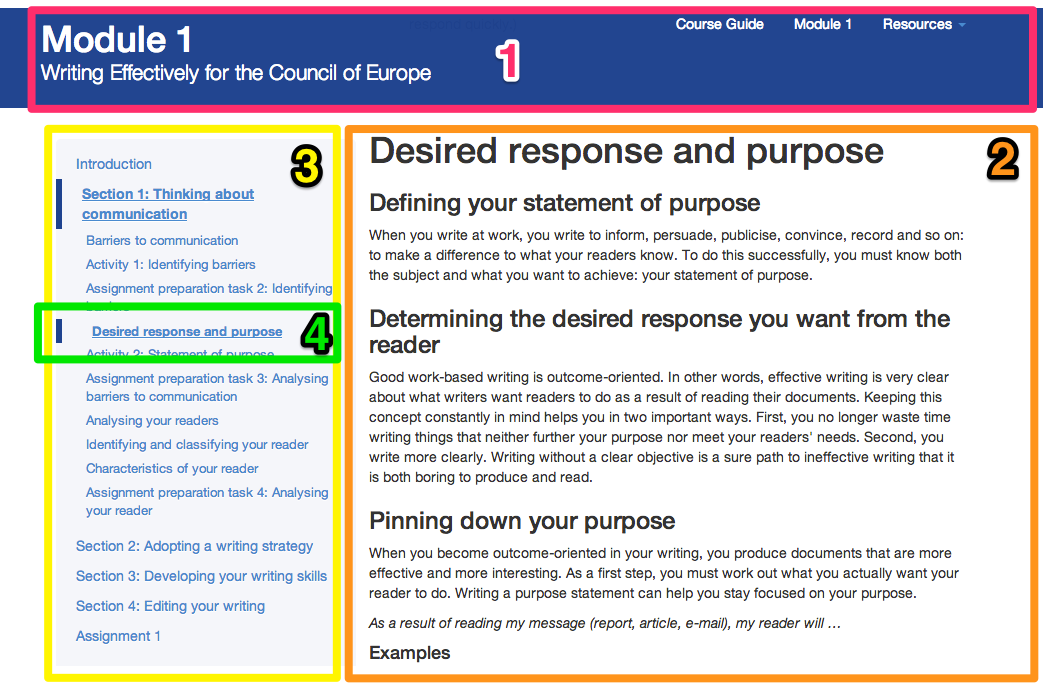
- 1) This is the course header
- It shows which module you are viewing and provides links to the other modules.
- You will also find a menu of course resources here. Resources include a link to print the module.
- 2) This is the content area
- This is where you scroll through all the content of each module.
- Various interactive activities are embedded into the content and appear here.
- Links to documents that you may need to download also appear here.
- To search for specific content within a module, use your browser’s find tool (usually ctrl-f on Windows, cmd-f on Macs).
- 3) This is the left-side menu
- This menu is a map of the module and will help you navigate through each module.
- This menu shows main heading links. Click on any of these links and a fully expanded list of links will appear below it.
- 4) This is the title of the content page you are currently viewing
- As you scroll through the content area, this menu automatically updates to show you where you currently are.
- To bookmark a page, click the link you wish to bookmark in the left-side menu first, and then bookmark the page using your browser’s bookmark functionality.
Moodle: The Virtual Learning Environment
You and your tutor will communicate with each other through the online course environment called Moodle. Go to www.col-vle.org, log in and use the e-mail function to contact your tutor. You will have been given a temporary password to this site via regular e-mail by the Commonwealth of Learning administration.
Moodle is also the platform where you will submit all your assignments. Your tutor will review your assignments and return them there as well. Remember to take some time to familiarise yourself with this environment.
There are available guides to the Moodle functions in the Resource Section on Moodle. Please refer to them whenever necessary.
If you still have questions please consult your personal tutor via e-mail in Moodle.
Storing files
Each module has two different kinds of activities:
- self-marking activities, where you complete a task and then compare your answers with those suggested;
- assignment preparation tasks, which you complete as you work through the module. You complete these to collect data for the writing of the assignment.
The activities will be completed within the module, and you will not need to save the results for later.
You will be putting together your assignment preparation tasks to create your assignments for each module, so you will want to save those tasks somewhere easily accessible. You may choose to store these documents in a folder on your desktop. If you use multiple computers, you may find it most helpful to store them on a USB key. If you prefer, you may upload your work in progress to Moodle; Microsoft Word files can be uploaded to the "private files" area under the "my profile" section. It's up to you. (This area is just for you to store work in progress. When your work is ready for your tutor to review, you will upload it to the assignment area.)
In order to experience this course fully, you will need:
- a current browser, including Internet Explorer 10+, Firefox, Chrome or Safari.
- a screen size at least 992px wide.
Acknowledgements
Commonwealth of Learning
The Commonwealth of Learning (COL) is the only international intergovernmental agency that focuses exclusively on using technology to expand the scope and scale of human learning. It operates on the premise that knowledge is the key to individual freedom and to cultural, social and economic development.
COL helps Governments to develop policies that make innovation sustainable and to build systems or applications that expand learning.
The Chairman of the Board of Governors is the Honourable Burchell Whiteman, O.J. and COL's President and Chief Executive Officer is Professor Asha S. Kanwar.
Course Development Team
| Internal Partner, Council of Europe | Vanessa Meister, Head of Learning and Development Solutions Unit |
| Project Manager, Commonwealth of Learning | Angela Kwan |
| Writer/ Instructional Designer | Mary Wilson, Ph.D. |
| Educational Technologist | Joe Zerdin |
| Editor | Christie Tetreault |
Acknowledgement
The course development team would like to thank all those from the Council of Europe who generously donated their time and writing samples during a fact-finding mission to Strasbourg in August 2013. The use of authentic written materials is invaluable for a course like this one, and we are grateful for all the contributions of staff members.
© Council of Europe - 2013
Published by
Commonwealth of Learning1055 West Hastings Street, Suite 1200
Vancouver, British Columbia V6E 2E9 CANADA
Phone: +1 604 775 8200
Fax: +1 604 775 8210
Email: info@col.org
Web: http://www.col.org/colelio